


OnlyFans free pages present a spending puzzle that BestOnlyFans research has mapped through user-reported patterns and platform mechanics. The zero-dollar entry point creates an illusion of cost control while masking a revenue model built on variable micro-transactions. This article examines how psychological triggers, platform design, and distributed spending patterns convert free signups into expenses that often exceed paid subscriptions. Readers will learn to identify escalation tactics, establish financial guardrails, and recognize when a paid alternative offers better value.
The platform’s architecture separates free and paid pages at the subscription level only. Free creators earn through pay-per-view (PPV) messages, paid direct messages, and tips. Paid creators combine subscription revenue with these same additional streams. For subscribers, this means a free follow is not cost-free consumption—it is entry into a payment environment with fewer visible guardrails than traditional subscription models.

The Psychology of Free Entry
Zero-cost signup exploits a well-documented cognitive bias: loss aversion reciprocity. When someone receives something without payment, they experience mild psychological discomfort that creates pressure to restore balance. Free teaser content triggers this response. The subscriber has consumed value, feels an unconscious obligation, and the PPV unlock request arrives as a low-friction resolution to that tension.
The platform amplifies this through immediacy. Unlike a paid subscription where costs are front-loaded and sunk, free pages deliver ongoing “gifts” that refresh the reciprocity cycle. Each notification of new free content restarts the obligation clock. The $3-$5 unlock feels minor against this accumulated sense of having received something.
Concrete tip: Never link a debit card with overdraft protection. The platform processes small transactions rapidly; multiple $5 unlocks in sequence can trigger overdraft fees that exceed the original purchase amount. Use a dedicated prepaid instrument or a credit card with hard limit settings.
Social proof compounds the effect. Creators frequently reference “exclusive” access or limited availability in PPV previews. This transforms a simple transaction into a membership moment, tapping identity-based motivation rather than pure utility calculation. The subscriber is no longer buying a video; they are securing belonging.
Micro-Transaction Escalation Patterns
Spending on free pages rarely follows a linear path. Analysis of self-reported user patterns reveals a predictable escalation curve that begins with minimal commitment and ends at the platform’s $50 PPV maximum or sustained paid chat engagement.
- Initial curiosity unlock: A $3-$5 PPV message purchased to assess content quality
- Social proof trigger: “Exclusive” or “VIP” content claims prompting $10-$15 video unlocks
- Sunk cost justification: Continued spending rationalized by amounts already committed
- Scarcity pressure: Limited-time offers or countdown timers on premium content
- Community belonging through tipping: Ongoing small payments to maintain creator attention
The $0.10 card verification hold, refunded within days, serves as an unintentional checkpoint. Users who pause at this friction point—entering payment details for the first time—often do so with reduced deliberation for subsequent purchases. The initial hurdle becomes invisible.

Paid chat represents a particularly insidious escalation. At $3-$5 per message, a twenty-message conversation costs $60-$100—equivalent to four to twenty months of a standard paid subscription. The real-time nature obscures cumulative cost. Each message feels responsive; the total only becomes visible retrospectively.
The Aggregation Problem: Following Multiple Free Pages
Individual PPV purchases seem manageable. The critical failure point is distribution across multiple creators. Ten free follows, each generating modest monthly engagement, create spending that exceeds concentrated subscription costs while remaining cognitively invisible.
| Scenario | Predictable Monthly Cost | Surprise Risk Level |
|---|---|---|
| One $10 paid subscription | $10 | Low |
| Five free pages, light PPV | $15-$25 | Moderate |
| Five free pages, heavy PPV | $40-$75 | High |
| Ten free pages, mixed engagement | $30-$100+ | Very high |
| Uncontrolled browsing pattern | Unpredictable | Maximum |
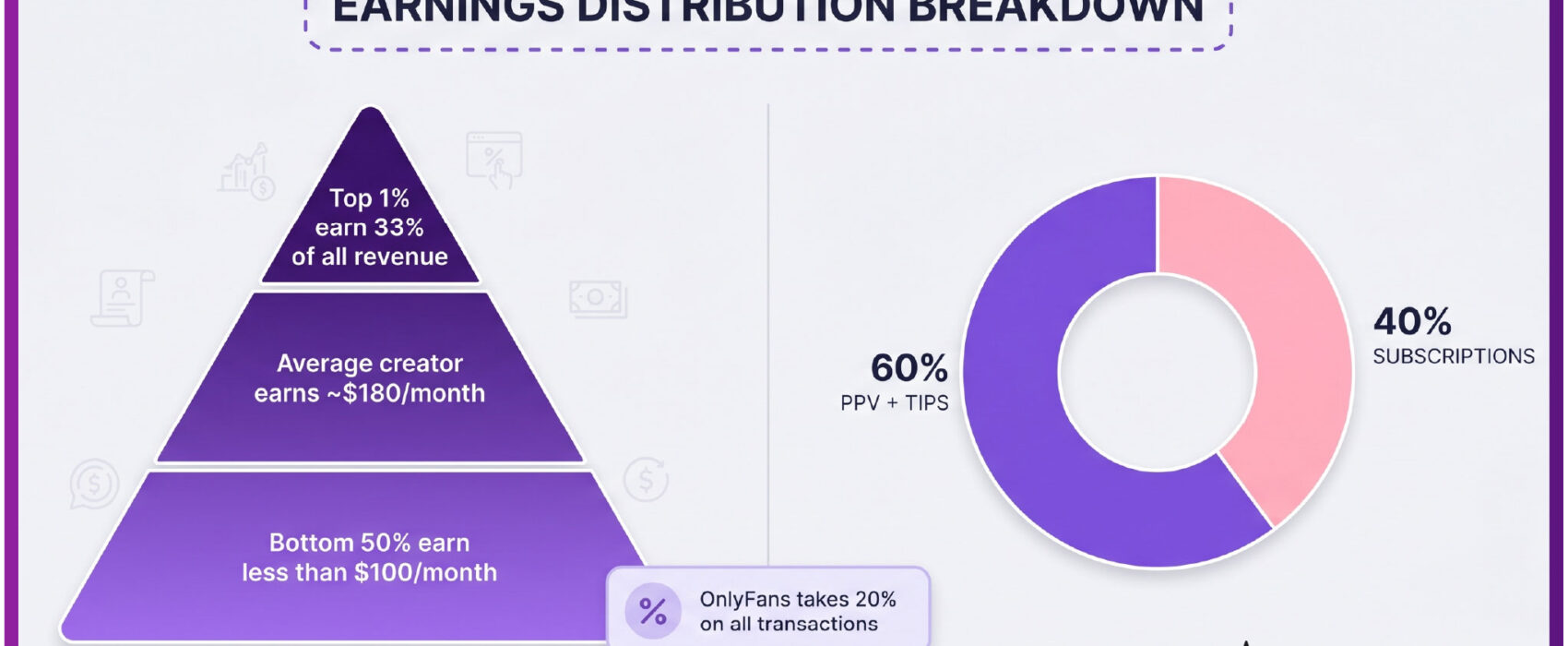
The platform’s 20% fee applies uniformly, but the subscriber experience differs radically. Paid subscriptions create one relationship with predictable cost. Free pages multiply relationships with variable, compounding expense.
- Overlapping PPV purchases: Multiple creators release content simultaneously, triggering competing unlock impulses
- Redundant tip requests: Each page operates independently, multiplying solicitation frequency
- Time spent managing notifications: Cognitive load reduces spending deliberation
- Difficulty tracking total spend: Fragmented purchase history across creators obscures monthly totals
- Fragmented content libraries: No centralized access, reducing perceived value of any single purchase

Platform Design Features That Encourage Overspending
OnlyFans lacks a discovery feed or content directory by design. This absence forces subscribers toward individual creator relationships rather than comparative shopping. For free page followers, it means each creator operates as a silo with customized pricing and urgency tactics.
Push notifications arrive without price disclosure. A “new message” alert conceals whether the content is free, PPV, or paid chat until opened. This asymmetry exploits curiosity patterns. The subscriber has already invested attention by checking; the incremental cost of unlocking feels small against that sunk attention.
Limited-time PPV previews create artificial scarcity through countdown timers. The platform does not disclose how these timers are set—whether by creator choice, automated suggestion, or algorithmic optimization. The effect remains: compressed decision timelines reduce price sensitivity.
Setting Hard Financial Boundaries
Prevention requires structural intervention rather than willpower. The platform’s native controls are minimal; subscribers must construct external guardrails.
| Boundary Type | Setup Effort | Effectiveness Duration |
|---|---|---|
| Prepaid cards | High | Permanent with reloading discipline |
| Wallet deposits | Low | Until depleted, requires renewal |
| Bank alerts | Medium | Indefinite, habituation risk |
| Manual logging | High | Dependent on consistency |
| Third-party budgeting apps | Medium | Data access dependent |
- Load-only prepaid cards with monthly limits: Isolate OnlyFans spending from primary accounts
- OnlyFans wallet with fixed deposits: Create a visible, depleting budget pool
- Bank alert thresholds at $20, $50, $100: Interrupt spending with friction notifications
- Weekly spend review on fixed calendar day: Force retrospective accounting
The $0.10 verification hold can serve as a deliberate pause point. Subscribers who treat this micro-transaction as a full spending decision—reviewing their month before confirming—create friction that subsequent purchases lack.

Recognizing When Free Page Costs Exceed Paid Alternatives
Conversion from free to paid requires honest accounting. The BestOnlyFans methodology suggests monthly comparison rather than per-purchase evaluation.
- Feed post quantity included: Paid pages typically offer unlimited timeline access versus unlock-dependent viewing
- Video length standard: Free PPV often segments content; paid subscriptions may include full-length material
- Messaging response rate: Paid subscribers often receive priority replies without per-message cost
- Custom request availability: Paid tiers frequently include request rights versus PPV-only access
- Total predictable monthly ceiling: The $4.99-$15 paid range versus uncapped PPV accumulation
Calculate cumulative PPV spend over ninety days. If this exceeds $30—three months at $10 or six at $5—the paid alternative likely offers superior value. The calculation must include time costs: managing multiple free pages versus single-subscription simplicity.
Promotional pricing complicates this. First-month discounts below $4.99 are permitted by platform rules; base prices are not. Factor the renewal price, not the teaser rate, into long-term comparisons.

Creator Tactics Versus Subscriber Control
Creator revenue needs are legitimate. The platform’s 20% fee leaves creators dependent on volume and upselling for sustainable income. This article does not critique pricing per se but rather the information asymmetry that prevents informed subscriber choice.
Fair pricing is transparent, consistent, and proportionate to delivered value. Exploitative escalation conceals total cost, varies pricing unpredictably, and leverages psychological pressure over value demonstration. Subscribers can distinguish these by asking: does this creator make cumulative cost visible? Do they acknowledge when PPV exceeds subscription alternatives?
Some creators provide clear pricing menus, bundle PPV at predictable rates, or explicitly recommend subscription conversion for heavy users. These practices respect subscriber agency. Others exploit the free-page model’s opacity. Readers curious about broader platform trust issues may wonder are free onlyfans accounts scams. This question misunderstands the mechanism: free pages are not fraudulent but rather designed for revenue extraction through behavioral patterns rather than upfront pricing.
Recovery Steps After Unplanned Free-Page Spending
Overspending on free pages is common and recoverable. Platform policy and financial tools provide exit routes.
- Immediately disable auto-renew on all free follows: Prevents subscription conversion that compounds costs
- Screenshot PPV purchase records: Documentation for potential disputes and personal accounting
- Contact OnlyFans support within 24 hours for billing errors: Rapid reporting improves resolution probability
- Switch to single-use virtual cards for future follows: Isolates new exposure from compromised payment methods
The cancellation dialog, which surfaces during subscription management, requires explicit reason selection. This friction is minimal but present—use it as a final deliberation point before any paid commitment.

Refund success varies. Platform policy generally permits dispute of unauthorized charges or technical failures, not buyer’s remorse. The 80% creator share complicates partial refunds—platforms resist clawing back distributed revenue. Prevention through spending boundaries remains superior to post-hoc recovery.
For sustained change, audit notification permissions. Platform alerts are opt-out by default; reducing their frequency removes trigger exposure. The BestOnlyFans approach emphasizes environmental design over self-discipline: structure your subscription ecosystem so that overspending requires active effort rather than prevention demanding constant vigilance.

FAQ
Can I set a spending cap directly within OnlyFans for free pages?
OnlyFans does not offer native spending caps for PPV, tips, or paid chat. The wallet feature allows fixed deposits, but once loaded, funds can be spent without additional confirmation. External tools—prepaid cards with load limits, bank alerts, or third-party budgeting applications—provide the only effective caps.
Why does my free page bill sometimes exceed what paid subscribers pay?
Free pages generate revenue through variable micro-transactions rather than fixed subscription fees. Multiple $3-$5 unlocks, paid chat at $3-$5 per message, and tips accumulate without the psychological anchoring of a monthly price. Ten free follows with modest engagement can easily exceed a single $10 subscription through distributed, less-visible spending.
What recourse do I have if a creator repeatedly sends high-priced PPV I didn’t request?
Block the creator to stop further messages. Report spam-pattern behavior through platform support channels. Document unsolicited PPV with screenshots. Platform policy prohibits harassment, but enforcement varies. Prevention—careful selection of follows, notification management, and spending boundaries—remains more reliable than post-hoc complaint resolution.
How quickly does OnlyFans process refunds for accidental PPV purchases?
Refund processing typically occurs within 5-10 business days for approved claims. The 20% platform fee structure means refunds often require creator consent or platform absorption of the creator share. Claims filed within 24 hours with clear documentation succeed more frequently. Technical failures (unplayable content, delivery errors) have stronger refund prospects than discretionary reversal of viewed purchases.